- 10-07-2026
- Computer Vision
Researchers have published a review highlighting how deepnetts and foundation models are transforming vision-based depth estimation by using standard cameras instead of costly sensors depth-sensing hardware.
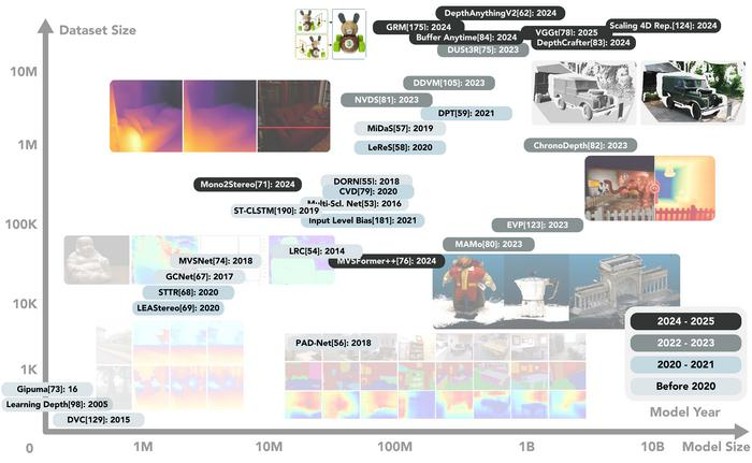
A recent review published in Computational Visual Media examines the rapid evolution of deep neural networks for vision-based depth estimation, an essential component of modern computer vision. Unlike traditional approaches that rely on LiDAR sensors, vision-based methods use standard cameras together with advanced AI models to estimate three-dimensional depth more efficiently and cost-effectively.
The review discusses the progress of foundation models across monocular, monocular video, stereo, and multi-view depth estimation techniques. These models have significantly improved their ability to generalize across different environments while providing more accurate and robust depth predictions. Researchers also highlight current challenges, including the need for larger datasets, improved consistency, and better performance on reflective and transparent surfaces.
As foundation models continue to advance, vision-based depth estimation is expected to play an increasingly important role in autonomous vehicles, robotics, industrial automation, augmented reality, virtual reality, and other intelligent computer vision applications.