- 12-08-2026
- Computer Vision
Every alert begins a decision-making process that depends on context, confidence and human judgement.
An alert is not a decision
Early wildfire detection is often discussed in terms of speed.
How quickly can smoke be detected?
How many minutes after ignition can an alert be generated?
How early can emergency services be notified?
These are important questions. Detecting a wildfire while it is still small can significantly reduce environmental damage, operational costs and risks to people and infrastructure. However, focusing only on detection overlooks an equally important challenge.
An alert, on its own, does not extinguish a fire.
Nor does it make an operational decision.
It simply marks the beginning of a much broader process.
For the teams responsible for protecting forests and communities, the first alert is not the end of monitoring. It is the point at which uncertainty begins to be reduced and decisions begin to be made.
As AI monitoring systems continue to evolve, their value will increasingly be measured not only by how quickly they detect events, but by how effectively they support the people responsible for deciding what happens next.
Every alert starts a workflow
From a distance, an AI system detects what appears to be a thin smoke plume.
An alert is generated.
At that moment, several questions immediately arise.
. Is it really smoke?
. Could it be steam, dust or another atmospheric phenomenon?
. Is the smoke increasing or dissipating?
. Is immediate intervention required?
. Should additional information be collected before resources are mobilised?
The alert itself answers only one question:
"Something unusual may be happening."
Everything that follows requires analysis, interpretation and operational judgement.
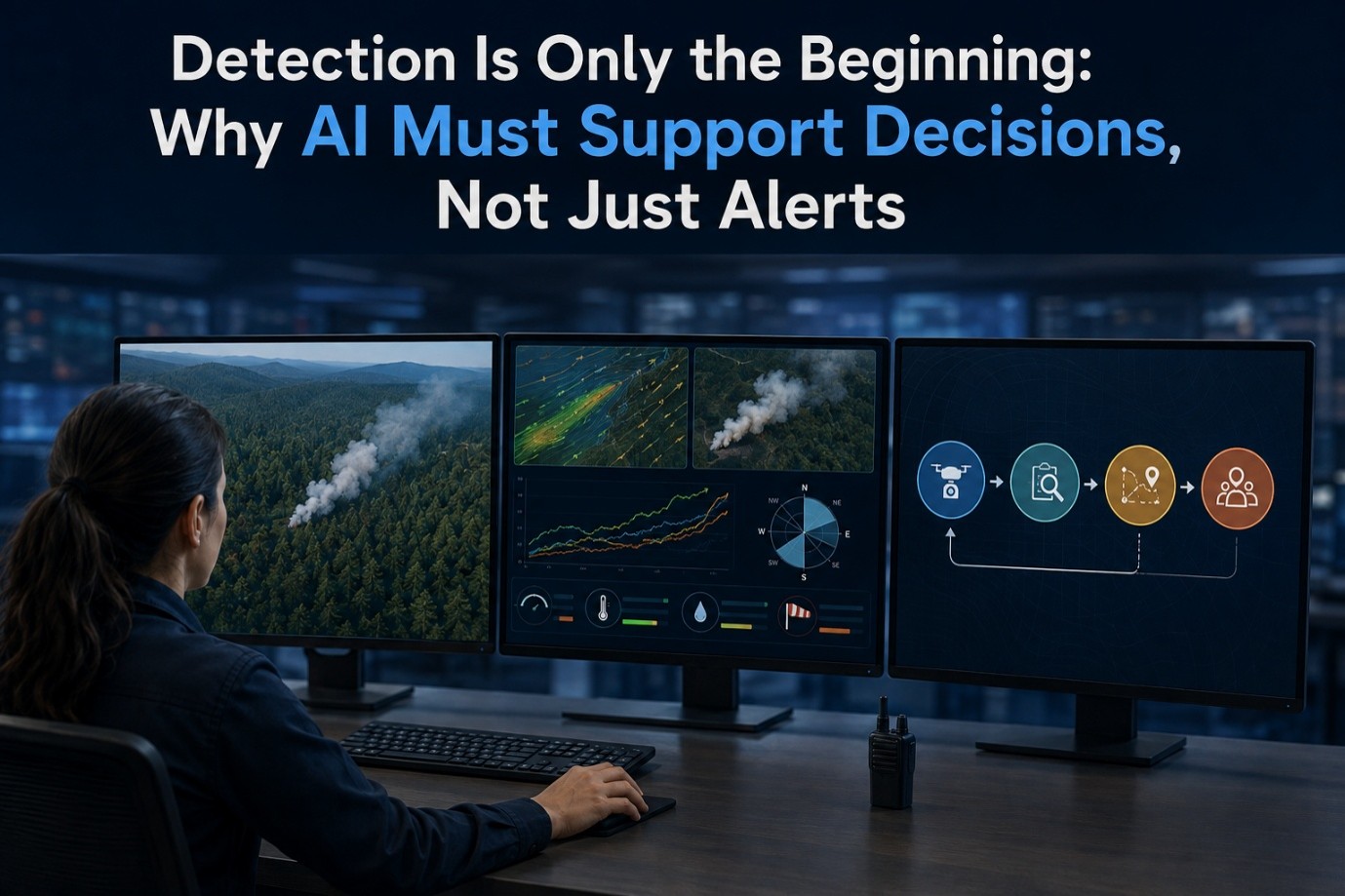
This is why monitoring systems should be designed to support an entire decision-making process rather than simply producing notifications.
Detection and decision are different problems
In many discussions about artificial intelligence, detection is presented as the primary objective.
From an engineering perspective, that makes sense.
Detection algorithms can be measured using metrics such as precision, recall and detection time.
Operational teams, however, evaluate systems differently.
They are less concerned with whether an algorithm correctly identified a smoke plume and more concerned with questions such as:
. Can I trust this alert?
. Do I have enough information to act?
. What is the potential consequence of waiting?
. What happens if this alert is ignored?
These questions cannot be answered through object detection alone.
They require context.
This distinction is important.
Detecting an event is a computer vision problem.
Supporting operational decisions is a systems problem.
The future of AI monitoring depends on solving both.
Why context matters
Imagine receiving two alerts.
Both indicate possible smoke.
The first alert simply highlights a location on a map.
The second also provides:
. previous observations from the same location;
. smoke evolution over several minutes;
. estimated confidence;
. weather conditions;
. camera history.
Which alert is likely to support a faster decision?
Both identify the same possible event.
But only one provides the context needed to reduce uncertainty.
Context transforms information into understanding.
And understanding is what supports decisions.
Monitoring does not stop after detection
One of the most common misconceptions in wildfire monitoring is that the objective is to detect smoke.
In reality, monitoring continues long after the first alert.
Operators observe how the situation evolves.
Does the smoke become denser?
Does it remain stationary?
Does it disappear after a few minutes?
Does it begin to spread?
These observations often influence operational decisions far more than the initial detection itself.
Continuous observation provides information that a single alert never can.
This is why persistent monitoring has become such an important characteristic of modern AI-powered systems.
Understanding change over time is often just as valuable as identifying the first sign of smoke.
Decision support is becoming the real differentiator
As AI models continue to improve, differences in pure detection performance are likely to become smaller.
Many systems will eventually become capable of identifying smoke with similar levels of accuracy.
The next major differentiator will therefore not simply be who detects smoke first.
It will be who helps operators understand what the detection means.
Decision support can include:
. confidence estimation;
. contextual information;
. event evolution;
. prioritisation;
. integration with operational workflows.
These capabilities do not replace human expertise.
They enhance it.
The objective is not to automate decisions.
It is to make human decisions better informed.
Human expertise remains essential
Artificial intelligence excels at continuously analysing large volumes of visual information.
Human operators excel at understanding broader operational context.
They consider factors that AI cannot fully evaluate in isolation, such as:
. resource availability;
. local priorities;
. operational constraints;
. weather forecasts;
. ongoing emergency response activities.
Effective monitoring systems combine both strengths.
AI continuously monitors and identifies potential events.
Human operators evaluate the broader situation and determine the appropriate response.
Rather than replacing people, AI increasingly serves as an intelligent assistant that reduces uncertainty and accelerates situational awareness.
Building monitoring systems around decisions
Designing an AI monitoring system therefore requires asking different questions.
Instead of asking only:
"Can we detect smoke earlier?"
It is equally important to ask:
. What information will operators need next?
. How can uncertainty be reduced quickly?
. How should multiple observations be combined?
. Which events deserve immediate attention?
. How can the system fit naturally into operational workflows?
These questions shift the focus from algorithms towards operations.
Ultimately, the effectiveness of a monitoring system depends not only on its ability to detect events, but on its ability to support the people responsible for responding to them.
How AiAction approaches this challenge
At AiTecServ, we believe early detection is only one component of an effective monitoring system.
Generating alerts is important.
Helping organisations understand those alerts is equally important. This is why AiAction is being developed with a broader objective than simply identifying potential events. By combining continuous monitoring, artificial intelligence and contextual analysis, the goal is to provide information that supports operational decisions rather than simply increasing the number of alerts. The focus is not on replacing human expertise. It is on helping organisations respond earlier, more confidently and with greater situational awareness.
Looking ahead
Wildfire monitoring is gradually evolving from image recognition towards intelligent decision support.
Future monitoring systems are likely to combine:
. continuous observation;
. contextual reasoning;
. environmental information;
. confidence estimation;
. multi-source data integration;
. AI-assisted operational workflows.
This evolution reflects a broader shift taking place across critical monitoring.
The question is no longer simply:
"Can AI detect something?"
Increasingly, it is:
"Can AI help us decide what to do next?"
Conclusion
Early wildfire detection remains essential.
But detection alone is no longer enough.
Every alert begins a decision-making process that depends on context, confidence and human judgement.
As monitoring technologies continue to evolve, the greatest value of artificial intelligence will not lie solely in recognising events.
It will lie in helping organisations understand those events quickly enough to make better decisions.
Because ultimately, an alert has little value until it helps someone decide what to do next.